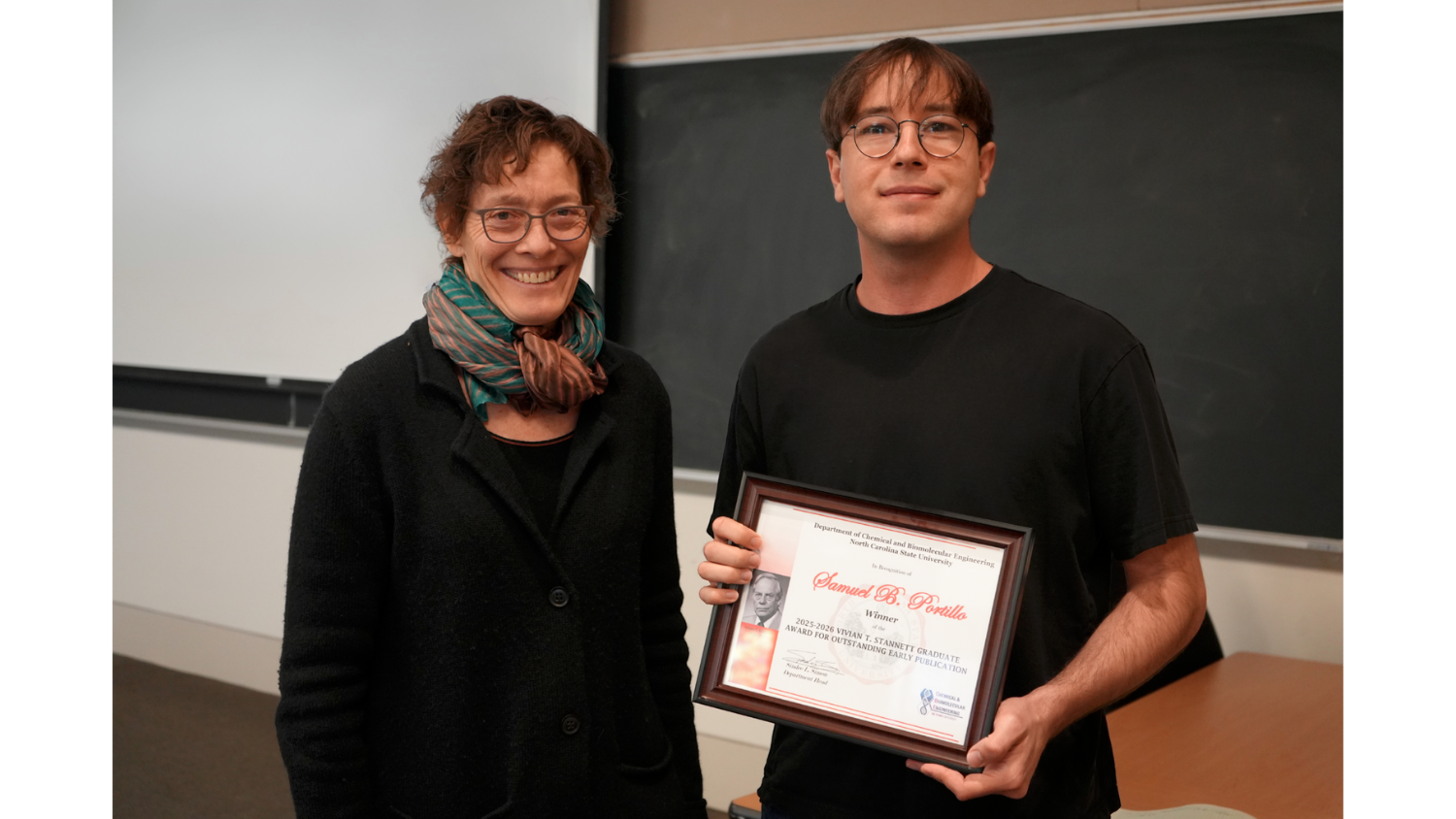
The 2025 Vivian T. Stannett Graduate Award for Outstanding Early Publication
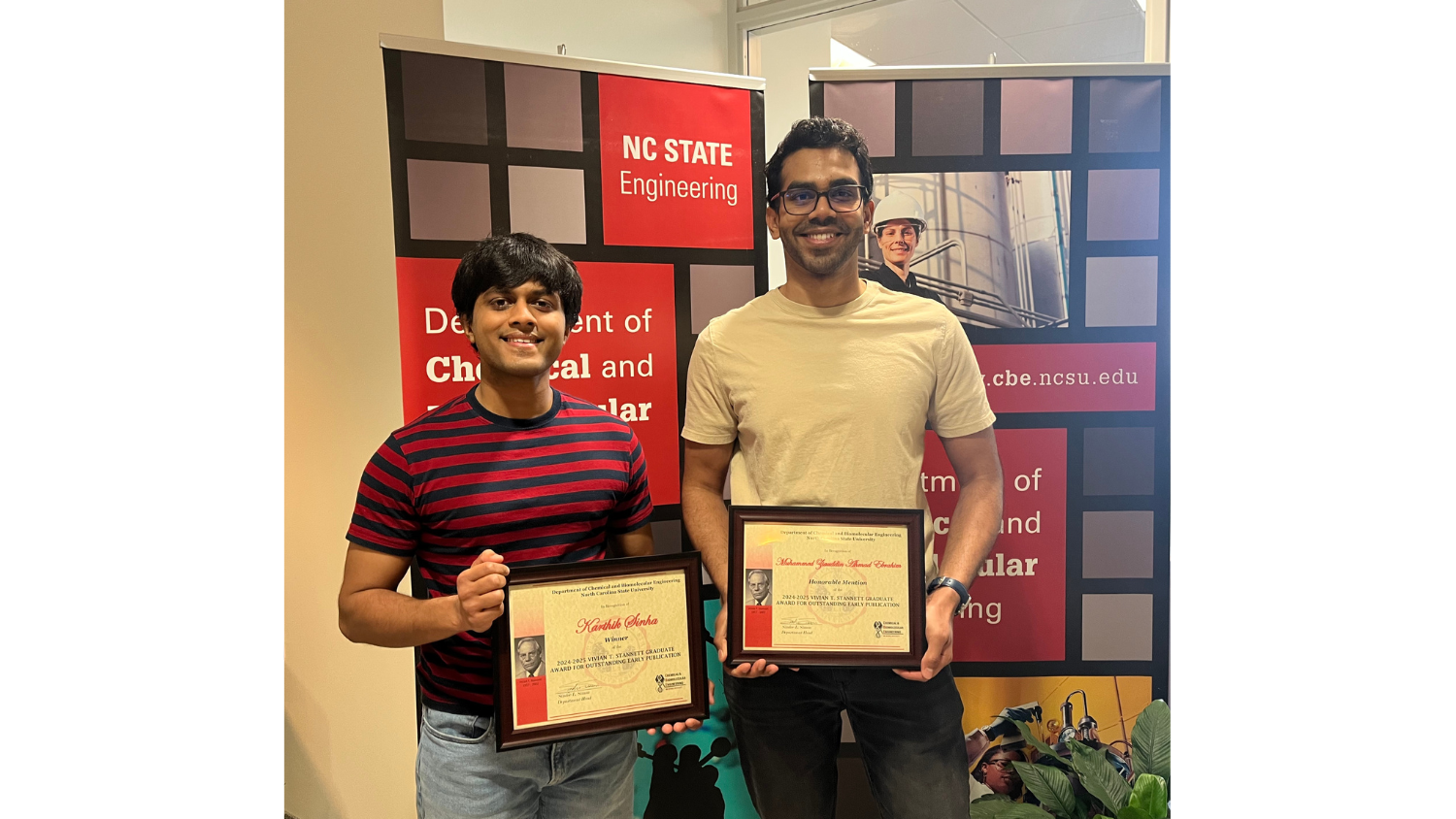
The 2025 winner and honorable mention for the Vivian T. Stannett Graduate Award for Outstanding Early Publication is Karthik Sinha and Muhammed Ziauddin Ahmad Ebrahaim, respectively.
The award recognizes research excellence, initiative, focus and tenacity during the early career of Ph.D. candidates in the department. It is named in memory of Prof. Vivian T. Stannett, a CBE faculty member who was an internationally renowned polymer scientist, research leader, and National Academy of Engineering member. Professor Stannett published over 400 research papers and reviews during his distinguished academic career.
Karthik Sinha
Karthik is a third year Ph.D. student and is advised by Prof. Artem Rumyantsev. This award recognizes his 2025 The Journal of Chemical Physics paper, “Polyampholyte sequence controls the type of electrostatic coil-globule transition in good solvent.”
Karthik’s paper advances the understanding of how sequence governs the conformational behavior of polyampholytes (PA) in a good solvent. The transition from a swollen coil to a condensed globule for PAs in a good solvent was demonstrated, for the first time using molecular dynamics simulations, to be highly sequence dependent: diblock and random PAs display a gradual crossover, whereas alternating sequences experience collapse akin to that in neutral polymer chains, with the second virial coefficient renormalized to account for effectively dipole dipole attractions between oppositely charged monomers.
Muhammed Ziauddin Ahmad Ebrahim
Zia is a fourth year Ph.D. student and is advised by Prof. Saad Khan. This award recognizes his 2025 Chemical Engineering Journal paper, “Janus layered nanofibrous aerogels with switchable wettability for targeted emulsion separation.”
Zia’s research focuses on designing a robust bilayered nanofibrous aerogel (NFA) for efficient oil-water separation, particularly addressing the challenge posed by surfactant-stabilized emulsions with micro-sized droplets that resist conventional separation techniques. Inspired by the dual-wettability of lotus leaf and building on our group’s earlier work on aerogels, Zia and coworkers developed a three-dimensional scaffold with distinct wetting layers (hydrophobic/hydrophilic) that enables gravity-driven, switchable separation of both oil-in-water and water-in-oil emulsions. The fabrication approach is environmentally friendly, avoids harsh solvents, and integrates magnetic nanoparticles for easy recovery and reuse. This work offers a transformative, scalable solution for wastewater treatment with potential applications beyond oil-water separation.
Congratulations to Karthik and Zia on your outstanding achievements!
- Categories: