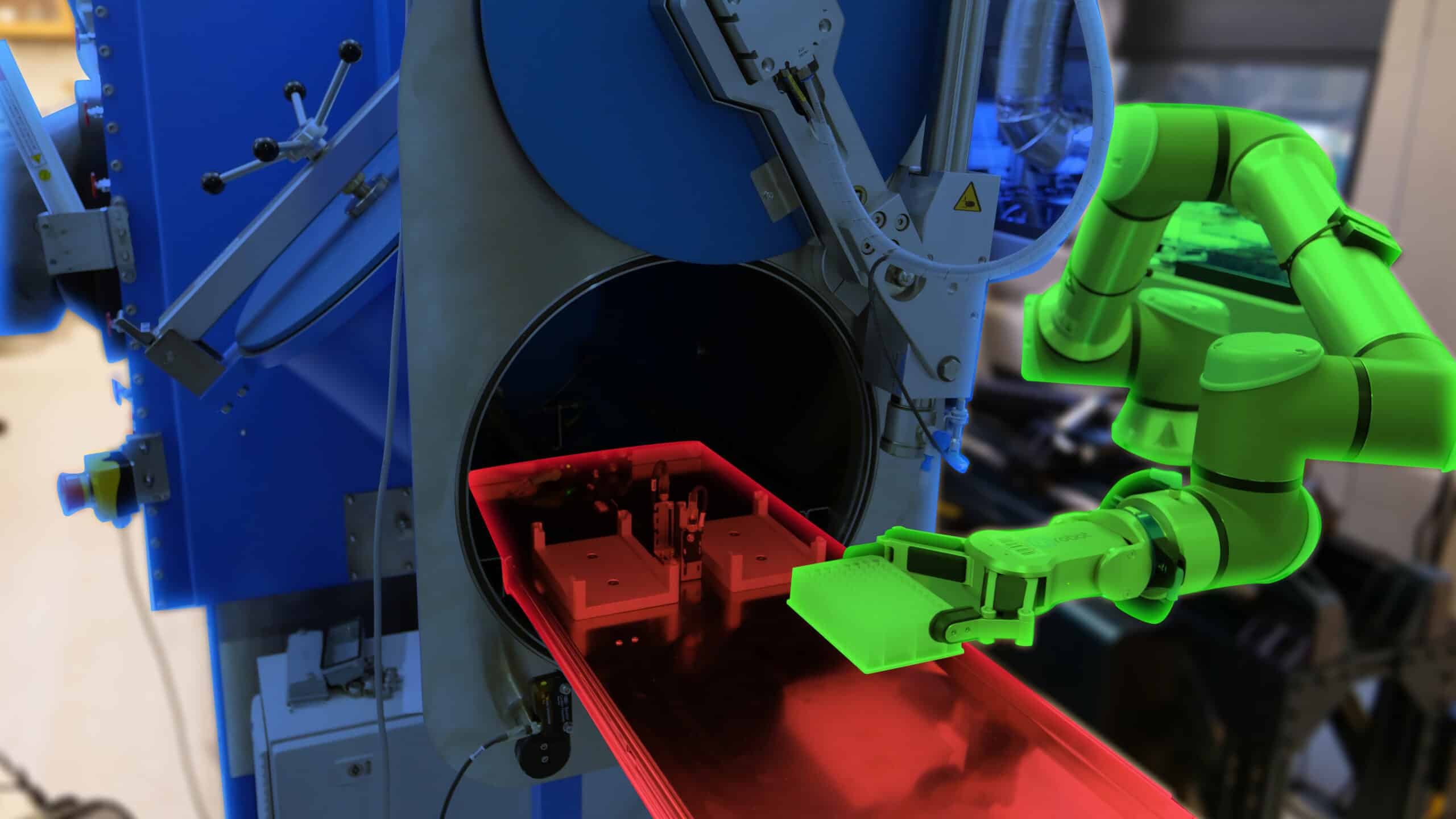
North Carolina State’s College of Engineering has been selected for a $2,992,500 award from the U.S. Department of Energy’s Advanced Research Projects Agency-Energy (ARPA-E) to accelerate the development of a self-driving laboratory for data-rich discovery of heterogeneous catalysts, the solid materials that make many fuel and chemical manufacturing processes faster, more efficient and more economical.
The project is led by Milad Abolhasani, Alcoa Professor and University Faculty Scholar in the Department of Chemical and Biomolecular Engineering, in collaboration with Fanxing Li, Thomas M. Clausi Distinguished Professor of Chemical and Biomolecular Engineering and University Faculty Scholar. The interdisciplinary team is developing an integrated human-AI-robot platform to autonomously design, synthesize, characterize and rapidly screen complex heterogeneous catalyst materials through closed-loop experimentation.
By combining AI-guided decision-making with robotics, high-throughput experimentation and advanced characterization, Abolhasani and his team aim to significantly increase the speed, efficiency and rigor of catalyst discovery. The project brings together innovations in automated synthesis, rapid catalyst screening and multiscale transport modeling to create a new paradigm for accelerated catalyst development.
“This work sits at the intersection of advanced materials discovery, autonomous labs and energy technologies,” said Abolhasani. “NC State has the people, facilities and institutional vision to lead in this space.”

Self-driving labs use automation, AI and real-time data to plan experiments, execute them, learn from results and continuously improve future decisions. In this project, the NC State-led team will develop a human-AI-robot discovery platform for heterogeneous redox catalysts, enabling faster and more data-rich exploration of composition-structure-performance relationships that are often difficult to uncover through conventional experimentation.
NC State has made major investments in autonomous experimentation and the research infrastructure needed to support this emerging area of science and engineering. The award builds on years of work in robotics, AI-guided experimentation and self-driving laboratory development across the university.
“Our team has spent years building the infrastructure and scientific and engineering foundation needed to make self-driving experimentation a reality,” said Abolhasani. “This award builds on that momentum and helps position NC State as a leading site for the convergence of AI, automation and chemistry.”
The project also reflects the strength of collaboration across academia and industry. In addition to NC State, the effort includes close collaboration with academic partners at Carnegie Mellon University and Virginia Tech, as well as industrial partners BASF and SABIC US. Together, the team brings complementary expertise in catalysis, modeling, robotics and scale-up.


NC State is one of only three university-led teams selected for the highly competitive award, alongside the University of Wisconsin-Madison and the University of Connecticut. Nine national laboratory-led teams were also awarded funding.
ARPA-E is investing $34 million for the 12 projects through the Catalytic Application Testing for Accelerated Learning Chemistries via High-throughput Experimentation and Modeling Efficiently (CATALCHEM-E) program. The initiative aims to harness AI and self-driving labs to reduce the time required for critical materials and energy technology development.
“ARPA-E supports bold ideas with the potential to reshape entire fields,” said Abolhasani. “Receiving this award is a strong affirmation of the vision we have been pursuing for years.”
- Categories: