From Pipettes to Pedagogy: Faculty Reflections of the Drive Behind Academia
CBE senior Anna Watson sat down with faculty to discuss their perspectives on a career in chemical engineering academia.
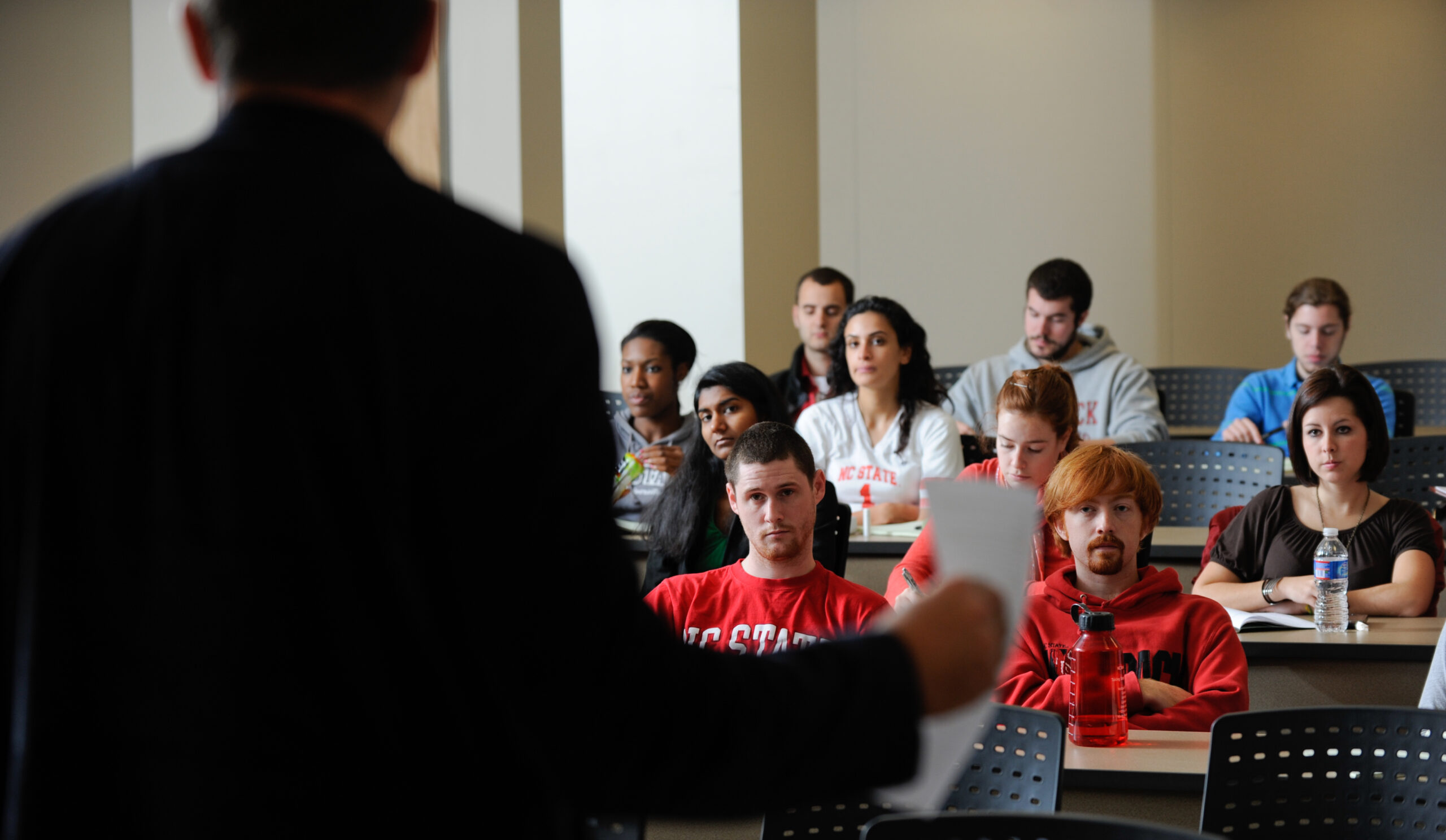
From a young age, students are asked a familiar question: “what do you want to be when you grow up?” It’s a question as old as time, and for a chemical engineer, the answer is far from simple. With the wide range of opportunities a chemical engineering degree can provide, how do students decide which path to pursue? What else does the field offer beyond the traditional technical roles introduced through coursework and industry examples? A common challenge is that students simply don’t know the full extent of what engineering can provide.
We don’t know what we don’t know. Between the career paths in pharmaceuticals, energy and consumer manufacturing lies an overlooked, but highly influential, option: academia. This article draws from a series of interviews with faculty in the Department of Chemical and Biomolecular Engineering at NC State. By speaking with professors who were once students in our shoes, I hoped to gain insight into their experiences in the field and the realities of working in an academic setting. Their perspectives offer both guidance, inspiration, and a broader perspective for students beginning their own careers.
Questions for the Faculty
What achievement, aspect or quality in your professional career are you the most proud of?
When walking into S. Frank and Doris Culberson Distinguished Professor Jan Genzer’s office, your attention might be drawn to the fifty-one champagne bottles which line the perimeter. Genzer simply explains, “those are my kids.” Each bottle represents a graduating doctoral student he has mentored, providing a powerful reflection of what he values most in his career. Genzer is most proud of the people he has been able to mentor and work with.
Nathan Crook, an associate professor, shared a similar notion. He notes that the students who graduate from the lab often go on to become professors themselves, contributing to a cycle of higher education. Beyond mentorship, Crook mentions the excitement behind researching novel ideas and the thrill of turning an original idea into motion.
Leah Granger, an assistant teaching professor, reflects on her passion for being a part of the community itself. “I’m still in shock that I’m here. I always looked up to my professors, I never thought I was up to that level. I’m very grateful that I’m here.”
Worley H. Clark Jr. Distinguished University Professor in Engineering Carol Hall echoes the importance of community in her experience as well, recalling her enjoyment of working with graduate students and involvement with the National Academy of Engineering.
What has been your favorite aspect of your professional career?
Genzer offers a simple observation, “you never grow old.” He explains that education is particularly unique in the way that professors are able to live vicariously through their students. Genzer states that the years go by and you age, but the students stay the same and bring refreshing perspectives to a career.
Michael Dickey, Camille and Henry Dreyfus Professor and Associate Department Head, expresses a similar distinction between industry and academia, stating, “in industry the product of your effort is something that can be sold, in academia the product is the people.”
Do you have any regrets in terms of your professional career? Are there any industries you wish you got to be involved in?
Blake Rasor, an assistant professor, shares that he would have liked more experience with computational tools such as Python or “R” during graduate school to support more detailed data analysis. He also shows interest in exploring the food or beverage industry alongside his biomanufacturing research.
In contrast, Genzer is direct in his own reflection. “I have no regrets. I love my job as a professor.” Hall similarly responded, “Not one bit. I took some risks but didn’t play it safe and it worked out.”
What do you believe is the most crucial part to standing out in the chemical engineering industry?
Erik Santiso, associate professor and University Faculty Scholar, acknowledges that while the standard answer might emphasize becoming widely recognized for what you do, he sees success differently. “Success can look different depending on who you ask,” he says.
Alexa Easley, an assistant professor, identifies critical thinking as one of the hardest aspects of chemical engineering to learn, but explains that if you demonstrate it well people will want to work with you. “It shows you have the ability to look at the field and identify gaps,” she says, adding, “think about prior published work with a critical mindset. No work is perfect, there’s always room for improvement.”
Rasor emphasizes the use of creative problem solving. “Some researchers overcomplicate a research problem, while others overhype small advances.” It’s his belief that while some chemical engineers use conventional methods for problem solving, those who use “elegant, outside the box” approaches are truly the ones who are noticeable.
Crook adds that discipline and time investment play a defining role. “Everybody has the same amount of time in the day. How you decide to spend your time, and how much you put into your work is the way to distinguish yourself. You can be successful and well respected without being the best in the field if you put in the time, it compounds.” He also observes that those who are able to translate hypothetical research into functional industry applications, alongside compassionate mentors, are highly notable.
Granger highlights perseverance in a different form, describing it as the ability to “sit in the discomfort of not knowing what path to take.” She points to the breadth of knowledge required in chemical engineering and the challenge of navigating it.
Where do you see the future of chemical engineering?
Granger is interested in seeing how computational simulations will help save time and money in the future. “With artificial intelligence computational models could be more powerful. For education, I think we’ll have to adapt to artificial intelligence, it’s something we can’t ignore.”
Richard Spontak, a recently retired distinguished professor of chemical, biomolecular and materials science engineering, particularly emphasizes the increasing interdisciplinary design of chemical engineering, stating “the boundary of chemical engineering is becoming incredibly blurred. The discipline is changing and expanding. The best aspect of a chemical engineering degree is that you learn how to think about opportunities in a broader sense. You discover how to think critically and apply problem-solving skills to a wide variety of professional and personal challenges.”
What piece of advice do you have for a student who is starting their career?
Spontak stresses the importance of fulfillment. “In my opinion, the most important aspect is to find a profession that brings fulfillment, satisfaction, and a sense of contribution.” He encourages students to think carefully about what they genuinely want from a career, rather than external expectations. “You shouldn’t go into a profession thinking you want to leave it. Finding the right career path up front is important so that decisions down the line come naturally, and without regret.”
Santiso advises students to keep an open mind. “Chemical engineering is an extremely broad field, you have a universe of possibilities that not a lot of people have. You might end up being surprised.”
Easley encourages experimentation without pressure. “It’s okay not to like something. If you’re interested in something, just try it. You don’t have to commit to it long term.” She also emphasizes that career paths are often nonlinear, noting her own experience working at a restaurant after her Ph.D. “Career paths outside of traditional engineering roles can be equally fulfilling and better match someone’s interests or passions.”
Dickey concludes with advice on the professional experience. “Just because something works for one person doesn’t mean it will work for everyone. Work hard, be kind, and stay curious and humble about life.”
Beyond the Classroom
The endless variety of chemical engineering careers can feel overwhelming – but that is what makes the field so compelling. Academia represents just one of many possible paths, yet it remains a unique space where ideas from multiple disciplines intersect and evolve.
For my fellow students, I hope that you have found insight, reassurance, or direction within these reflections. Whether your interests lie within academia or beyond it, the perspectives shared by these faculty members offer lessons that apply to all careers.
To the faculty who contributed their time and insight, thank you for your guidance and encouragement. This article is a small acknowledgment of your impact and inspiration you provide to future generations of chemical engineers.
ABOUT THE AUTHOR

Anna Watson
A senior chemical engineering undergraduate student at North Carolina State University, concentrating on sustainable engineering, energy and the environment.
- Categories: